


In years gone by, a business directory was just a digital version of the Yellow Pages. Today, it is a high-performance landing page. Most people will see your directory listing or your Google Business Profile before they ever set foot on your actual website.
When someone searches for a service “near me,” they are usually ready to buy. They aren’t looking for a history lesson; they are looking for proof that you can solve their problem right now. If your listing is incomplete or has old information, you are essentially closing your shop front while customers are standing on the footpath.
1. Accuracy and the “NAP+W” Consistency Rule
The first step in any Business Listing Optimization strategy is ensuring your basic details are correct. In the world of Local SEO, we focus on “NAP+W”—which stands for Name, Address, Phone Number, and Website.
Consistency is the most important factor here. If your business is listed as “Melbourne Coffee Co.” on one site and “Melbourne Coffee Company” on another, search engines can get confused. They might see these as two different businesses or, worse, decide your information is not reliable. This lowers your Entity Trust, which is how search engines determine if you are a real, legitimate business worth recommending.
Make sure your details match exactly across every platform, from your own website to directories like Find Local Business. Even a small difference in how you write your street address (like “St” vs “Street”) can have a minor impact over time.
2. Keyword Research: Speaking Your Customer’s Language
A perfect listing uses the same language your customers use when they are searching for help. This is where Local Intent comes in. Most people are not just looking for a “plumber”; they are looking for a “plumber in Brisbane” or a “blocked drain specialist.”
To find the right words, think about the specific problems you solve. Instead of just listing your services, include Semantic Keywords—these are terms naturally related to your main business. For example, if you run a gym, related terms might include “personal training,” “group fitness classes,” or “weight loss programs.”
Avoid “keyword stuffing,” which is the old habit of cramming as many words as possible into a paragraph. It makes the text hard to read and can actually get you penalised. Instead, aim for Semantic Density, where you naturally use terms that prove you are an expert in your niche.
3. Crafting a Description That Sells
Your business description is your elevator pitch. You usually only have a few seconds to grab someone’s attention before they scroll to the next option.
Start with a strong “Hook.” State exactly what you do and who you do it for in the first two sentences. Use a “Benefit-First” approach. Instead of saying “We have a big warehouse,” try “Find everything you need in one place with our massive range of local stock.”
This is also where you establish your E-E-A-T—Experience, Expertise, Authoritativeness, and Trustworthiness. Mention how long you’ve been serving the local community or any specific certifications you hold. This builds immediate rapport with the reader.
4. Visual Storytelling: The Power of Imagery
We are visual creatures. A listing without photos is like a shop with the curtains closed. High-quality imagery acts as Visual Verification for your business. It shows people that you are real, professional, and ready for work.
You should aim to include at least five to ten photos. These should cover:
- The Exterior: This helps people recognise your building when they arrive.
- The Interior: This gives customers a feel for the atmosphere.
- Your Team: Showing the faces behind the brand builds a human connection.
- Your Work: If you are a tradie, show before-and-after shots. If you are a cafe, show your best-selling dishes.
Using “Geotagged” images—photos that have location data attached—can also give your local SEO a slight boost by proving to search engines that the photos were actually taken at your place of business.
5. Leveraging Social Proof (Reviews & Ratings)
Reviews are the modern-day word-of-mouth. Most Australians will check your star rating before they even think about clicking your website link. This is called Social Proof, and it is one of the strongest Behavioral Signals that search engines use to rank you.
It isn’t just about having a five-star rating; Review Velocity (how often you get new reviews) and Review Recency (how old the reviews are) matter just as much. A business with 50 reviews from three years ago looks less reliable than a business with 10 reviews from the last month.
Always respond to your reviews, both the good and the bad. Replying to a negative review in a professional, helpful way can actually impress potential customers more than a perfect record. It shows you are a real person who cares about customer satisfaction.
6. The “Call to Action” (CTA): Turning Browsers into Buyers
The biggest mistake many businesses make is giving the customer all the information but not telling them what to do next. Your listing should end with a clear instruction.
Do you want them to call you? Visit your shop? Book an appointment online? Use direct phrases like “Book Your Free Quote Today” or “Visit Our Showroom in Perth.” A strong CTA turns a passive reader into an active lead.
In 2026, many platforms now allow for direct messaging or WhatsApp Integration. If you enable these features, make sure someone is actually monitoring them. A fast response can secure a job before the customer has a chance to message your competitor.
7. Keeping the Content Fresh
A business listing is not a “set and forget” task. Markets change, and so does your business. If you change your opening hours for a public holiday or start offering a new service, update your listing immediately.
Search engines love Active Listings. Regularly updating your photos or posting a quick update about a sale tells the algorithm that your business is thriving. This keeps you at the top of the “Local Pack”—the top three featured results that appear on the map in a search.
8. Optimising for the Future: Voice and AI Search
As we move further into 2026, more people are using voice assistants like Siri or Alexa, and AI tools like ChatGPT, to find local services. These “Answer Engines” look for clear, conversational data.
By writing your listing in a natural, human way and answering common questions (like “Is there parking available?” or “Do you offer emergency repairs?”), you are performing AEO or Answer Engine Optimisation. This ensures your business is the one the AI recommends when someone asks a question.
9. Using Video to Stand Out
While photos are essential, video is becoming the “cheat code” for local visibility. A short 30-second clip of your team at work or a quick tour of your premises can significantly increase the time a user spends on your listing. This “Dwell Time” is a signal to search engines that your content is interesting and relevant.
You do not need a professional film crew. A steady shot on a modern smartphone, good lighting, and a clear voice-over are often more effective because they feel authentic.
You may also like:
Summary Checklist for the Perfect Listing
To make sure you haven’t missed anything, here is a quick checklist to run through before you hit “publish”:
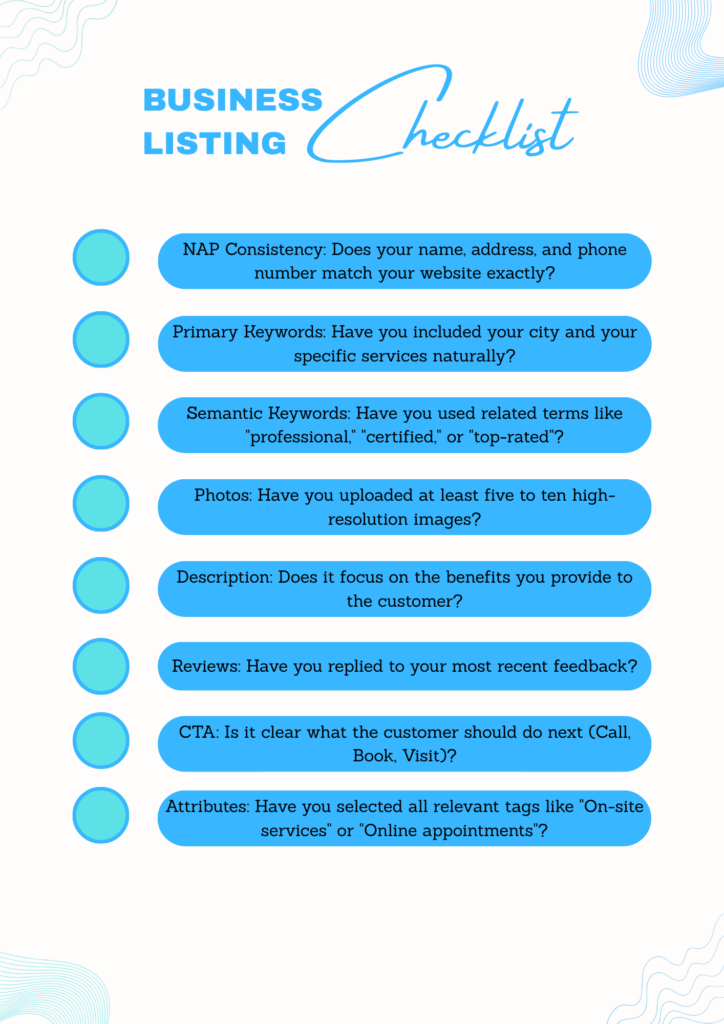
NAP Consistency
NAP stands for Name, Address, and Phone Number, and these details must match perfectly everywhere your business appears online. Search engines cross-reference your information across directories, maps, and websites to confirm that your business is legitimate. If small variations appear—such as “Suite 3” in one listing and “Unit 3” in another—it can weaken trust signals and reduce your local ranking potential.
Take the time to standardise how your business name, address, and phone number are written. Use the exact same format on your website, your business listings, and your profiles across the web. Consistency strengthens your entity authority, helping search engines confidently recommend your business to local customers.
Primary Keywords
Primary keywords describe what you do and where you do it. These are typically service-based phrases combined with a location, such as “electrician in Perth” or “family lawyer Gold Coast.” When someone searches for a service near them, search engines use these terms to determine which listings are most relevant.
Your listing description should naturally include your primary service and the city or area you serve. Avoid forcing the keywords into every sentence; instead, use them where they make sense so the text still reads smoothly for human visitors.
Semantic Keywords
Semantic keywords are related terms that support your main service. They help search engines understand the broader context of what you offer and demonstrate topical relevance. For example, a dentist might include phrases such as “teeth whitening,” “cosmetic dentistry,” and “preventative dental care.”
Using these related terms naturally builds a richer description of your services. Instead of repeating the same keyword over and over, semantic language shows both users and search engines that your listing provides genuine expertise within your industry.
Photos
Images play a critical role in building trust. A listing filled with clear, professional photos immediately feels more credible than one with no visuals at all. Potential customers often use photos to decide whether a business feels approachable, professional, and legitimate.
Include a mix of images that show your location, your workspace, your team, and examples of your work. Fresh photos also signal activity to search engines, which can help keep your listing visible in local results.
Description
Your description is your opportunity to explain why customers should choose you. Rather than listing features, focus on the benefits your service provides. People want to know how you will solve their problem quickly and reliably.
Start with a clear opening that explains what your business does and who it serves. Then highlight what makes your business trustworthy—such as experience, certifications, local knowledge, or customer satisfaction.
Reviews
Customer reviews are one of the strongest trust signals in local search. Positive reviews reassure potential customers that others have had a good experience with your business. They also send strong engagement signals to search engines, which can influence your ranking in local results.
Responding to reviews is just as important as collecting them. Thank customers for positive feedback and address negative reviews professionally. This demonstrates that you care about customer experience and are actively managing your reputation.
Call to Action (CTA)
A strong listing does more than inform—it guides the customer toward the next step. A call to action clearly tells visitors what they should do after reading your listing. Without this guidance, potential customers may simply move on to another option.
Use simple and direct instructions such as “Call now for a free quote,” “Book your consultation today,” or “Visit our showroom.” A clear CTA transforms your listing from a passive information page into a lead-generating asset.

Attributes
Attributes are the small tags and features that provide additional information about your business. These might include options such as “online appointments,” “on-site services,” “wheelchair accessible,” or “after-hours service.” While they may seem minor, they can influence whether your listing appears for specific searches.
Selecting all relevant attributes helps customers quickly determine if your business fits their needs. It also improves how search engines categorise your listing, increasing the chances that it appears when someone searches for services with those specific features.
Final Thoughts
By taking the time to polish these sections, you are not just filling out a form—you are building a high-converting asset that works 24/7. A well-written business listing is one of the most cost-effective marketing tools available to Australian small businesses today.
The digital landscape in Australia is only getting more competitive. As more businesses realise the importance of Online Visibility, those who provide the most accurate, engaging, and helpful information will be the ones who stay at the top of the search results. If you haven’t updated your profile lately, now is the time to start. Small changes in your description or adding a few fresh photos can lead to a noticeable jump in your local rankings and, more importantly, your sales.
