


Quick Overview: What is a Local Citation?
A local citation is any online mention of your business name, physical address, and phone number (NAP) across web directories, social media, and mapping apps. For business owners, building consistent local seo citations across trusted platforms like Google Business Profile and Yellow Pages is one of the most critical ranking factors for search engine optimisation. Maintaining identical details across all online directories dramatically improves your local seo visibility, builds algorithmic trust, and helps potential customers find your business in localised Google searches.
In the contemporary digital landscape, establishing a robust online presence is no longer a luxury reserved exclusively for multinational corporations. For local businesses operating within distinct geographical communities, digital real estate is the lifeblood of customer acquisition. When a resident conducts Google searches for an immediate solution—whether that involves locating a reliable plumber, an accountant, or a boutique café—the search engine must decide which business listings deserve prime placement.
At the absolute epicentre of this algorithmic selection process sits a foundational concept known as the local citation. If you are aiming to elevate your local seo visibility, understanding how to strategically deploy and manage these digital references is paramount. This guide provides an exhaustive exploration of what citations are, why they remain critical ranking factors, and how to execute a flawless local citation building strategy to ensure consumers can effortlessly find your business.
Defining the Core Concept: What is a Local Citation?
To put it in the simplest terms, what is a local citation? A local citation is any online mention of a business’s core identifying details—traditionally structured around the business name, physical address, and telephone number. In the search engine optimisation (SEO) industry, this core triad is universally referred to as the NAP data.
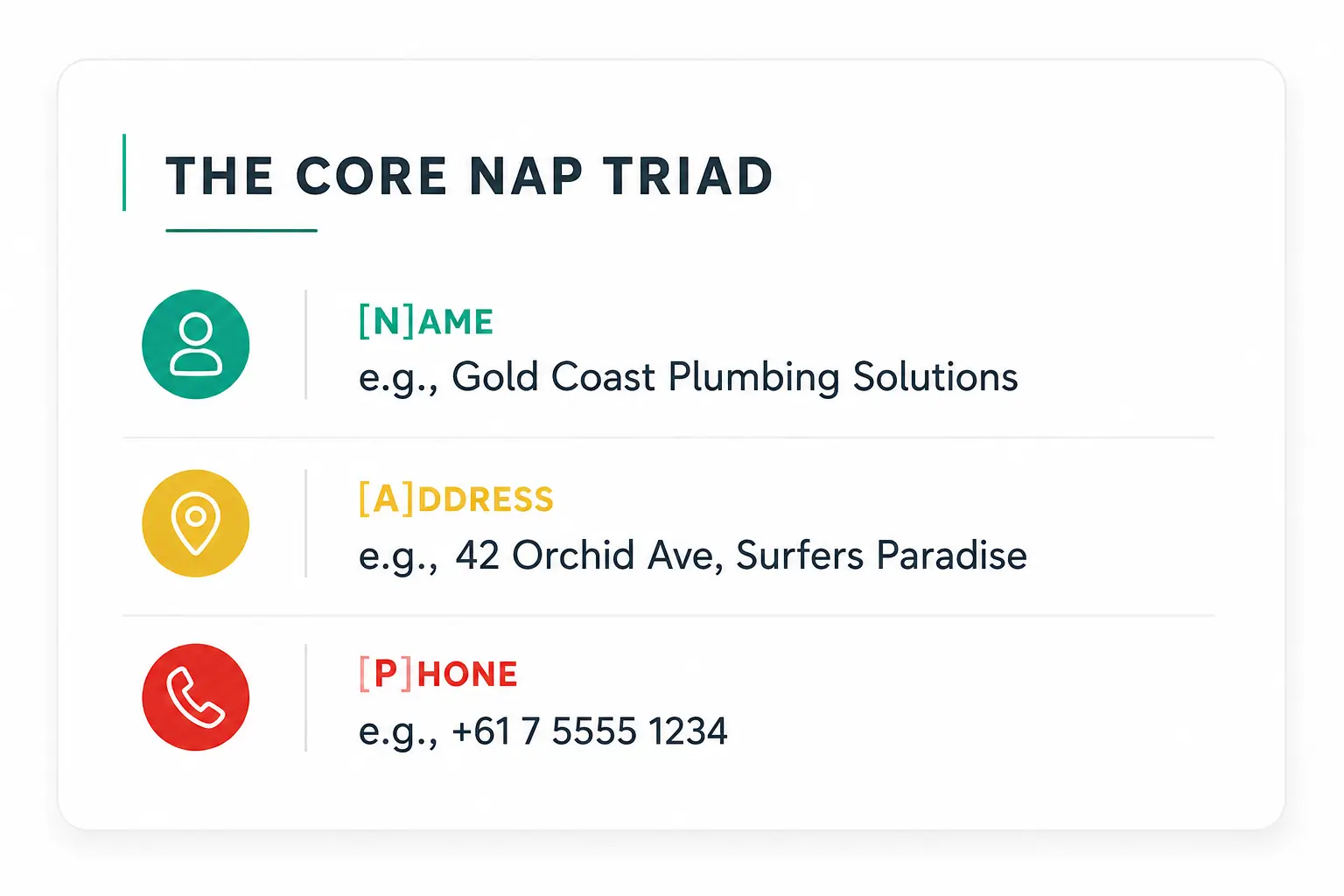
A citation does not strictly require a direct hyperlink back to your website to carry SEO value. Instead, the mere textual mention of your formal business details on a public platform signals to search engine crawlers that your enterprise is an active, legitimate entity operating within a specific market.
While the fundamental NAP data forms the baseline of any citation, a truly optimised profile goes significantly deeper. Comprehensive citations across the web typically incorporate a broader spectrum of secondary business intelligence, including:
Website URL: Directing traffic to your primary digital storefront.
Business Category: Classifying your industry accurately (e.g., “Family Medical Practice”).
Opening Hours: Keeping prospective patrons informed of operational routines.
Social Media Profiles: Linking together your broader brand ecosystem.
Reviews and Photos: Providing user-generated validation and visual context.
💡 Did You Know?
According to a comprehensive local search study by Whitespark, local citations are not just a static ranking factor; they actively influence the proximity component of Google’s local search algorithm.
Even if your business lacks an extensive backlink profile, clean and consistent distributed citations give search engines the geographic confidence required to surface your business online to nearby users executing immediate search queries.
The Anatomy of Citations: Structured vs Unstructured
Not all citations are created equal. To build a highly effective local seo strategy, business owners must recognise the distinct operational differences between the two primary classifications of citations: structured and unstructured.
Structured Citations
Structured citations are the most common and easily recognisable forms of business listings. They occur within formal online directories where the underlying data framework is rigidly defined. When you submit your details to these platforms, you fill out specific, dedicated fields for your name, address, phone number, and category.
Prominent global and regional examples of structured citation sources include:
Google Business Profile (GBP): The undisputed heavyweight of local search.
Apple Maps & Bing Places: Critical alternatives for mobile and desktop ecosystems.
Traditional Online Directories: Established platforms such as the Yellow Pages, True Local, and Local Search.
Industry-Specific Aggregators: Platforms tailored to niches, like TripAdvisor for hospitality or Houzz for trade professionals.
Unstructured Citations
Conversely, unstructured citations occur when your business details are mentioned in a less formalised, free-flowing text environment. These are typically generated through digital PR, content marketing, or community engagement.
Common origins for unstructured citations include:
Blog Posts: An influential local food blogger mentioning your restaurant’s name and address within a review.
Local News Websites: A digital feature article in a regional newspaper covering a community event your company sponsored.
Social Media Mentions: Informally structured references within community groups, public forums, or informational posts.
While unstructured citations are often more challenging to acquire than filling out forms on online storefronts, search engine algorithms place a high premium on them because they represent organic, authoritative editorial endorsements.
Why Citations are Crucial Ranking Factors for Search Engines
To understand why search engines place such significant weight on these directories, one must look at the primary objective of a search query. When a user executes a hyper-local search query, Google’s primary obligation is to deliver a set of results that are safe, operational, relevant, and physically accessible.
Verifying Enterprise Legitimacy
The internet is inherently filled with outdated data, ghost businesses, and spam listings designed to manipulate search positions. Google uses widespread local citation data as an automated cross-referencing verification system. If a search engine discovers your NAP details identical across fifty independent, reputable online directories, its confidence increases exponentially regarding the validity of your business online. It acts as a digital vote of confidence, proving you physically exist where you claim to operate.
Dominating the Local Pack
When users look for proximity-based services, Google displays a distinct map-based module at the very top of the organic search results, widely known as the local pack.

Securing a spot within this coveted three-listing layout is the ultimate goal of local optimisation. Extensive industry research consistently highlights that robust, authoritative citation profiles are among the most influential algorithmic ranking factors determining which entities earn placement in this premium map space.
Expanding Peripheral Online Visibility
Beyond direct search engine algorithms, citations directly impact how potential customers discover your services. Not every consumer utilises Google exclusively; many go directly to specialised online directories or mapping applications depending on their device ecosystem or personal preferences. By systematically executing a rigorous process of local citation building, you effectively place digital signposts across the entire internet, maximising the pathways through which a consumer can find your business.
The Non-Negotiable Rule of Local SEO: Absolute Consistency
If there is a single element within a local seo strategy that can make or break your organic performance, it is data consistency. Inconsistent NAP information across the web is one of the most destructive self-inflicted wounds an enterprise can suffer.
Consider the hypothetical example of an Australian medical clinic that relocates from Suite 4 to Suite 12 within the same commercial complex, or changes its primary contact number during an office upgrade. If the business updates its details exclusively on its primary website but neglects its distributed online directory footprint, a deeply problematic scenario unfolds:
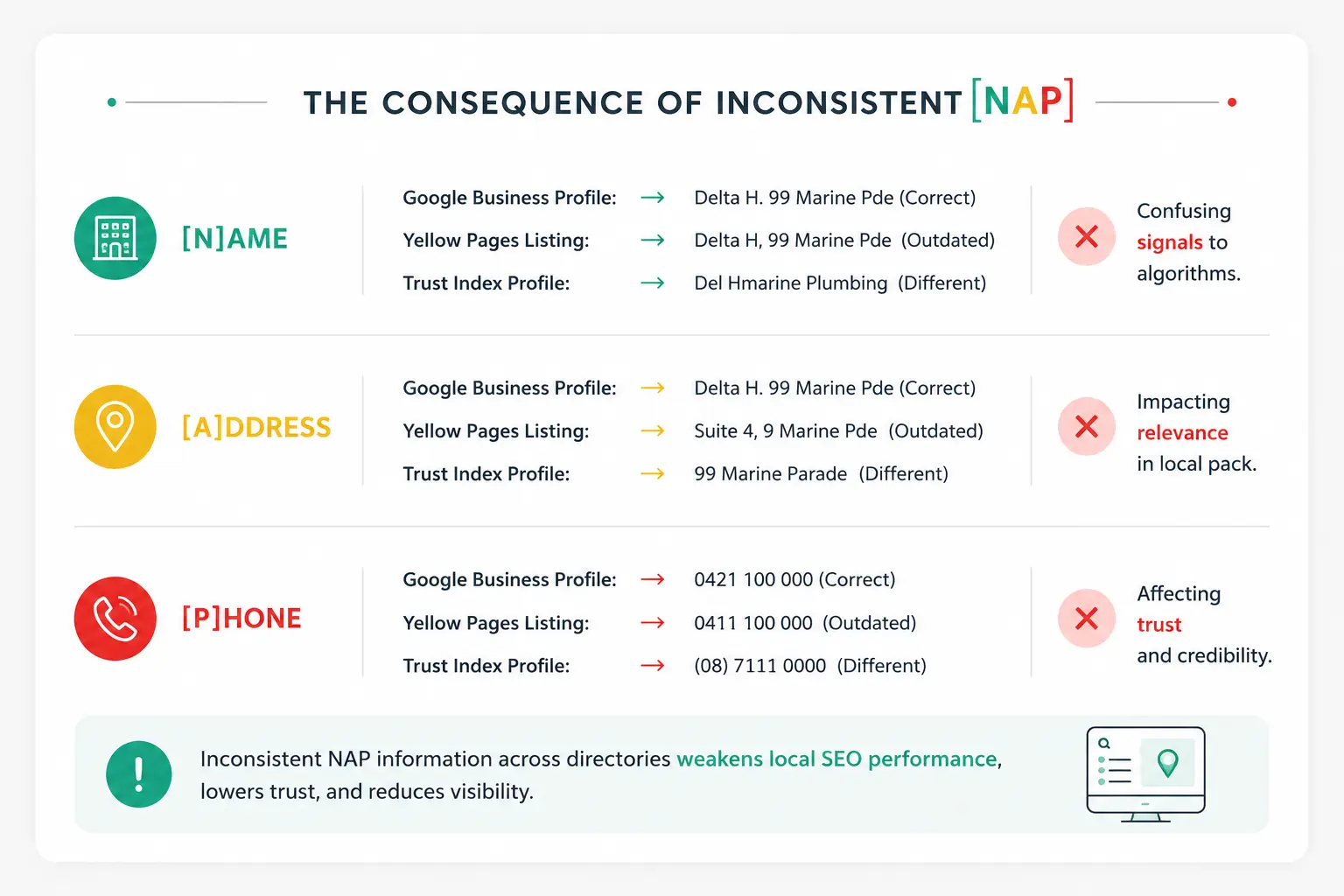
When search engine crawlers encounter conflicting geographical markers or disconnected contact lines, the algorithm experiences structural confusion. Because Google refuses to risk directing a consumer to an incorrect address or a dead phone line, it will instinctively suppress that business’s visibility in favor of a competitor whose data is clean and uniform.
Furthermore, inconsistency damages customer trust. A prospective client who drives to an outdated address found on a secondary business directory will quickly abandon the enterprise and leave negative feedback, severely disrupting your ability to accumulate positive reviews.
A Step-by-Step Guide to Build Local Citations Correctly
Embarking on a comprehensive local citation building campaign requires precision, patience, and meticulous organisation. Follow this structured roadmap to execute the process flawlessly.
Step 1: Establish Your Definitive Ground-Truth Document
Before typing a single character into an external directory web form, create a central master document containing your absolute, non-negotiable business information. Document precisely how your business name is written, down to the exact placement of commas, spacing, and legal identifiers (e.g., “Pty Ltd”).
Decide on a standardised formatting style for your address lines (e.g., choosing consistently between “Unit 3, 100 Main Street” or “3/100 Main St”) and stick to it universally. Copying and pasting directly from this master document ensures absolute human error is eliminated during data entry.
Step 2: Claim Your Primary Core Identifiers
Your initial wave of development must focus on the authoritative foundational pillars of search. Secure, claim, and exhaustively populate your profiles on:
Google Business Profile
Apple Maps Connect
Bing Places for Business
Facebook Business Pages
Ensure every available optional field—including secondary photo galleries, detailed service descriptions, and specific attributes—is completely fulfilled.
Step 3: Target the Major National Data Aggregators
In many regional economies, a vast network of smaller local directories draw their database info directly from centralised data ecosystems. By submitting your verified master data directly to these core foundational aggregators, your accurate information automatically trickles down to hundreds of peripheral search systems across the web over time.
Step 4: Systematically Populate Tier-1 Local Directories
Dedicate targeted operational hours to manually setting up accounts on the premier high-traffic directories specific to your country. In Australia, prioritise the submission of your data to trusted, high-domain platforms such as:
| Directory Platform | Focus Type | Priority Level |
| True Local | General Business | High |
| Yellow Pages Australia | Traditional Utility | High |
| Yelp Australia | Consumer Review | High |
| Word of Mouth (WOMO) | Reputation-Centric | Medium-High |
| Aussie Web | Geo-Targeted | Medium |

Step 5: Execute Hyper-Local and Industry-Specific Audits
Once the broad national directories are accounted for, shift focus to hyper-targeted opportunities. Search out localised business chambers, regional commerce groups, and neighborhood directory portals. Simultaneously, identify authoritative platforms specific to your professional trade or vertical. A local lodging provider must be immaculately mapped on TripAdvisor and Booking.com, whereas a local electrical contractor must focus on trade-matching portals.
Auditing and Cleaning Up Existing Legacy Citations
For established enterprises that have operated for several years, the immediate challenge is rarely building new citations, but rather correcting the chaotic trail of historical data left behind. Businesses evolve—they change names, update branding, transition to new tracking phone numbers, or move corporate offices.
To clean up your historical footprint, you must systematically execute a comprehensive citation audit:
Run a Discovery Audit: Use professional search operators or digital tools to scan the web for historical iterations of your business name, old phone numbers, or previous addresses.
Document Misinformation: Build a spreadsheet logging every rogue, inaccurate, or duplicate listing discovered during the exploration phase.
Initiate Corrections: Systematically reach out to directory administrators or log into legacy accounts to claim the listings and manually overwrite the faulty records with your modern master dataset.
Purge Duplicates: Ensure that no single directory contains two competing profiles for your business, as internal duplicate listings heavily dilute algorithmic equity and fragment your consumer reviews.
💡 Did You Know?
As documented by Mailchimp, duplicate or incorrect business data across different online directories can negatively impact how search engine algorithms view your business online. Keeping your listings consistent ensures search engines trust your operational details, directly helping your brand’s visibility.
Conclusion: Maximising the Long-Term ROI of Your Local Footprint
Elevating your brand’s organic performance is a compounding process that rewards precision and longevity. While standard global search strategies rely heavily on complex link frameworks and continuous content production, local visibility relies heavily on building a rock-solid, verified, and highly consistent digital footprint across the web.
By understanding the mechanics of local seo citations, acknowledging the severe penalties of messy cross-platform data, and committing to a structured methodology to systematically build local citations, you lay down the ideal foundational framework required to capture high-intent regional traffic. Ensure your business details are immaculate, maintain an active relationship with your directory profiles, encourage your clientele to leave positive reviews, and watch your local market dominance sustainably scale.
FAQs Regarding Local Citations
1. What is a local citation?
A local citation is any online mention of a business’s core identifying details, specifically its Name, Address, and Phone number (NAP). These occurrences can appear on online directories, websites, mapping applications, or social media platforms.
2. Why are citations important for local SEO?
Citations act as a foundational ranking factor by validating the legitimacy, physical location, and operational existence of an enterprise. Accurate data across the web signals trust to search engine algorithms, increasing your local seo visibility in the local pack.
3. What is the difference between structured and unstructured citations?
Structured citations occur inside formalised business directories (such as Yellow Pages or Google Business Profile) that enforce dedicated field inputs. Unstructured citations consist of casual textual mentions across digital blog posts, news features, or community forum updates.
